<?xml version="1.0" encoding="utf-8"?><feed xmlns="http://www.w3.org/2005/Atom" ><generator uri="https://jekyllrb.com/" version="4.3.2">Jekyll</generator><link href="/feed.xml" rel="self" type="application/atom+xml" /><link href="/" rel="alternate" type="text/html" /><updated>2023-07-10T20:49:42-07:00</updated><id>/feed.xml</id><title type="html">CalcBox</title><subtitle>For Calc II Stuff.</subtitle><author><name>NOTORIEX LEGACY</name></author><entry><title type="html">Textbook Section 11.3 Question 29 Solutions</title><link href="/solutions/written/images/TextbookSection11Part3Q29/" rel="alternate" type="text/html" title="Textbook Section 11.3 Question 29 Solutions" /><published>2023-07-10T20:46:00-07:00</published><updated>2023-07-10T20:46:00-07:00</updated><id>/solutions/written/images/TextbookSection11Part3Q29</id><content type="html" xml:base="/solutions/written/images/TextbookSection11Part3Q29/"><![CDATA[<script src="https://cdn.mathjax.org/mathjax/latest/MathJax.js?config=TeX-AMS-MML_HTMLorMML" type="text/javascript"></script>

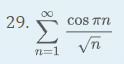
<h3 id="question">Question</h3>
<h3><i>Determine whether the series is convergent or divergent.</i></h3>
<p><img src="/assets/images/Textbook11-3Q29.png" width="800" height="600" /></p>

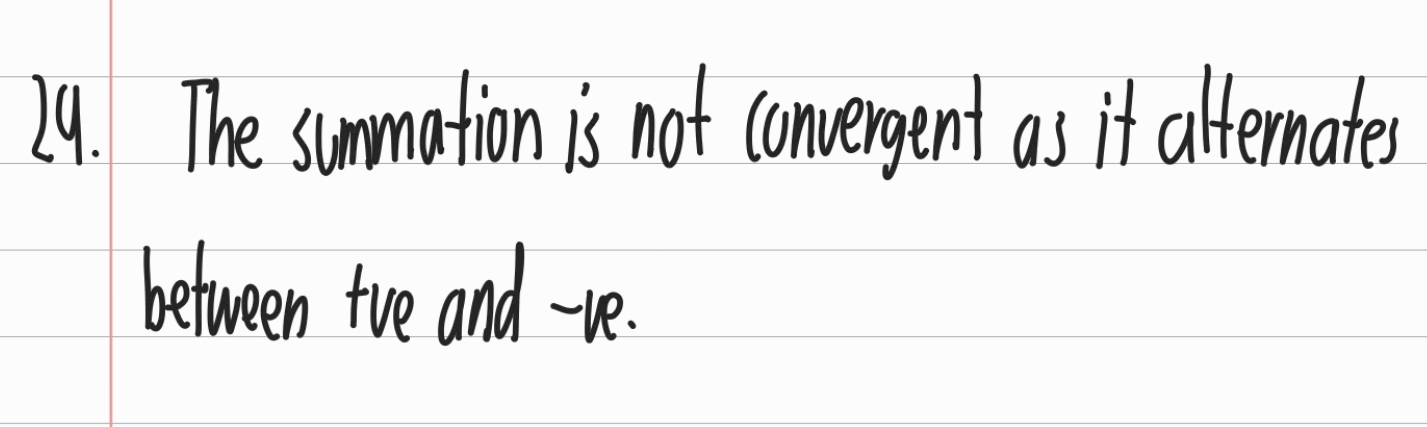
<h3 id="solutions">Solutions</h3>

<p><img src="/assets/images/SmartSelect_20230710_204700_Samsung Notes.jpg" width="800" height="600" /></p>

<p><a href="/">&lt;— Return Home</a></p>]]></content><author><name>NOTORIEX LEGACY</name></author><category term="solutions" /><category term="written" /><category term="images" /><category term="textbook" /><category term="stewart" /><category term="Early Transcendentals" /><category term="calculusii" /><summary type="html"><![CDATA[]]></summary></entry><entry><title type="html">Textbook Section 11.3 Question 27 Solutions</title><link href="/solutions/written/images/TextbookSection11Part3Q27/" rel="alternate" type="text/html" title="Textbook Section 11.3 Question 27 Solutions" /><published>2023-07-10T20:44:00-07:00</published><updated>2023-07-10T20:44:00-07:00</updated><id>/solutions/written/images/TextbookSection11Part3Q27</id><content type="html" xml:base="/solutions/written/images/TextbookSection11Part3Q27/"><![CDATA[<script src="https://cdn.mathjax.org/mathjax/latest/MathJax.js?config=TeX-AMS-MML_HTMLorMML" type="text/javascript"></script>

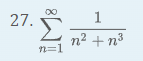
<h3 id="question">Question</h3>
<h3><i>Determine whether the series is convergent or divergent.</i></h3>
<p><img src="/assets/images/Textbook11-3Q27.png" width="800" height="600" /></p>

<p>First of all, we try to find out the summation series of the series.</p>

<p>Then, we use the Integral Test here which is:</p>

<ul>
  <li>
    <p>If \(\int_1^\infty f(x) \, dx\) convergent, then \(\sum_{n=1}^{\infty} a_n\) is convergent.</p>
  </li>
  <li>
    <p>If \(\int_1^\infty f(x) \, dx\) convergent, then \(\sum_{n=1}^{\infty} a_n\) is divergent.</p>
  </li>
</ul>

<p>Then you basically take the \(\lim_{m \to \infty} \int_1^m f(x) \, dx\) which in this case is \(\frac{1}{n^2 + n^3}\).</p>

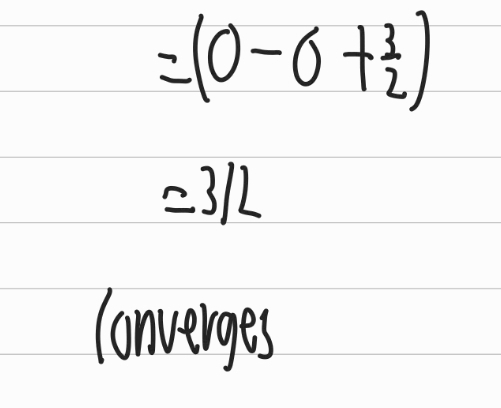
<p>You proceed to take the integral with Power Rule and then finally taking the limit.</p>

<p>Since the limit exists, it converges which is the final answer.</p>

<h3 id="solutions">Solutions</h3>

<p><img src="/assets/images/113 Practice_230710_124041 (6).jpg" width="800" height="600" /></p>

<p><img src="/assets/images/SmartSelect_20230710_204339_Samsung Notes.jpg" width="800" height="600" /></p>

<p><a href="/">&lt;— Return Home</a></p>]]></content><author><name>NOTORIEX LEGACY</name></author><category term="solutions" /><category term="written" /><category term="images" /><category term="textbook" /><category term="stewart" /><category term="Early Transcendentals" /><category term="calculusii" /><summary type="html"><![CDATA[]]></summary></entry><entry><title type="html">Textbook Section 11.3 Question 25 Solutions</title><link href="/solutions/written/images/TextbookSection11Part3Q25/" rel="alternate" type="text/html" title="Textbook Section 11.3 Question 25 Solutions" /><published>2023-07-10T20:40:00-07:00</published><updated>2023-07-10T20:40:00-07:00</updated><id>/solutions/written/images/TextbookSection11Part3Q25</id><content type="html" xml:base="/solutions/written/images/TextbookSection11Part3Q25/"><![CDATA[<script src="https://cdn.mathjax.org/mathjax/latest/MathJax.js?config=TeX-AMS-MML_HTMLorMML" type="text/javascript"></script>

<h3 id="question">Question</h3>
<h3><i>Determine whether the series is convergent or divergent.</i></h3>
<p><img src="/assets/images/Textbook11-3Q25.png" width="800" height="600" /></p>

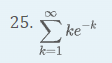
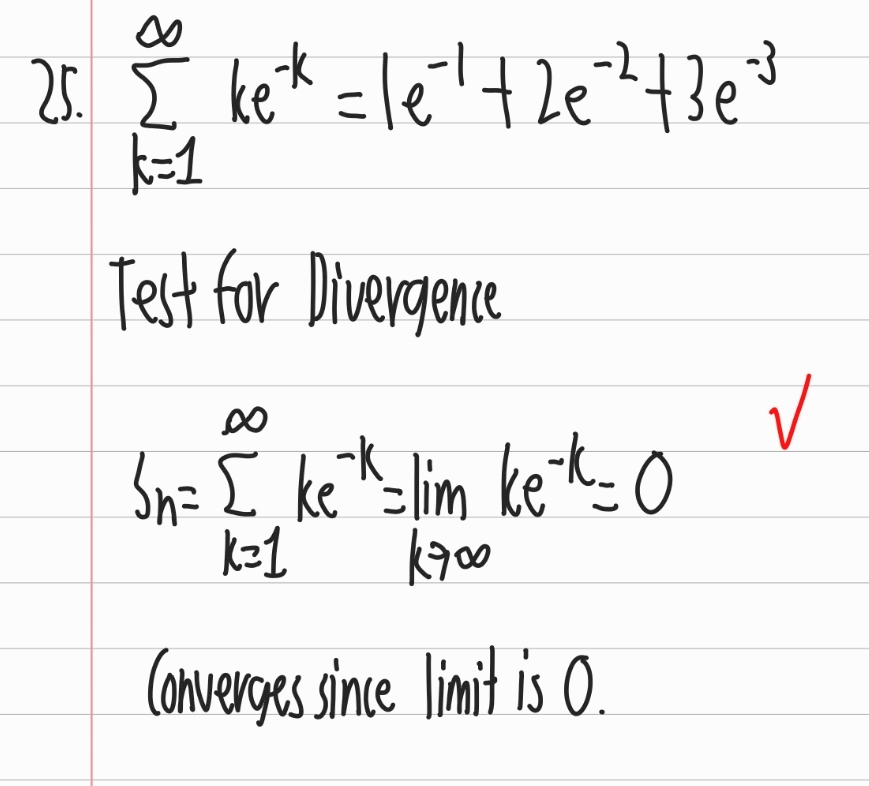
<p>We use the Test for Divergence where we take the summation as \(\lim_{k \to \infty} ke^{-k}\) which is \(0\).</p>

<p>It converges since the limit is 0.</p>

<h3 id="solutions">Solutions</h3>

<p><img src="/assets/images/SmartSelect_20230710_204137_Samsung Notes.jpg" width="800" height="600" /></p>

<p><a href="/">&lt;— Return Home</a></p>]]></content><author><name>NOTORIEX LEGACY</name></author><category term="solutions" /><category term="written" /><category term="images" /><category term="textbook" /><category term="stewart" /><category term="Early Transcendentals" /><category term="calculusii" /><summary type="html"><![CDATA[]]></summary></entry><entry><title type="html">Textbook Section 11.3 Question 23 Solutions</title><link href="/solutions/written/images/TextbookSection11Part3Q23/" rel="alternate" type="text/html" title="Textbook Section 11.3 Question 23 Solutions" /><published>2023-07-10T20:34:00-07:00</published><updated>2023-07-10T20:34:00-07:00</updated><id>/solutions/written/images/TextbookSection11Part3Q23</id><content type="html" xml:base="/solutions/written/images/TextbookSection11Part3Q23/"><![CDATA[<script src="https://cdn.mathjax.org/mathjax/latest/MathJax.js?config=TeX-AMS-MML_HTMLorMML" type="text/javascript"></script>

<h3 id="question">Question</h3>
<h3><i>Determine whether the series is convergent or divergent.</i></h3>
<p><img src="/assets/images/Textbook11-3Q23.png" width="800" height="600" /></p>

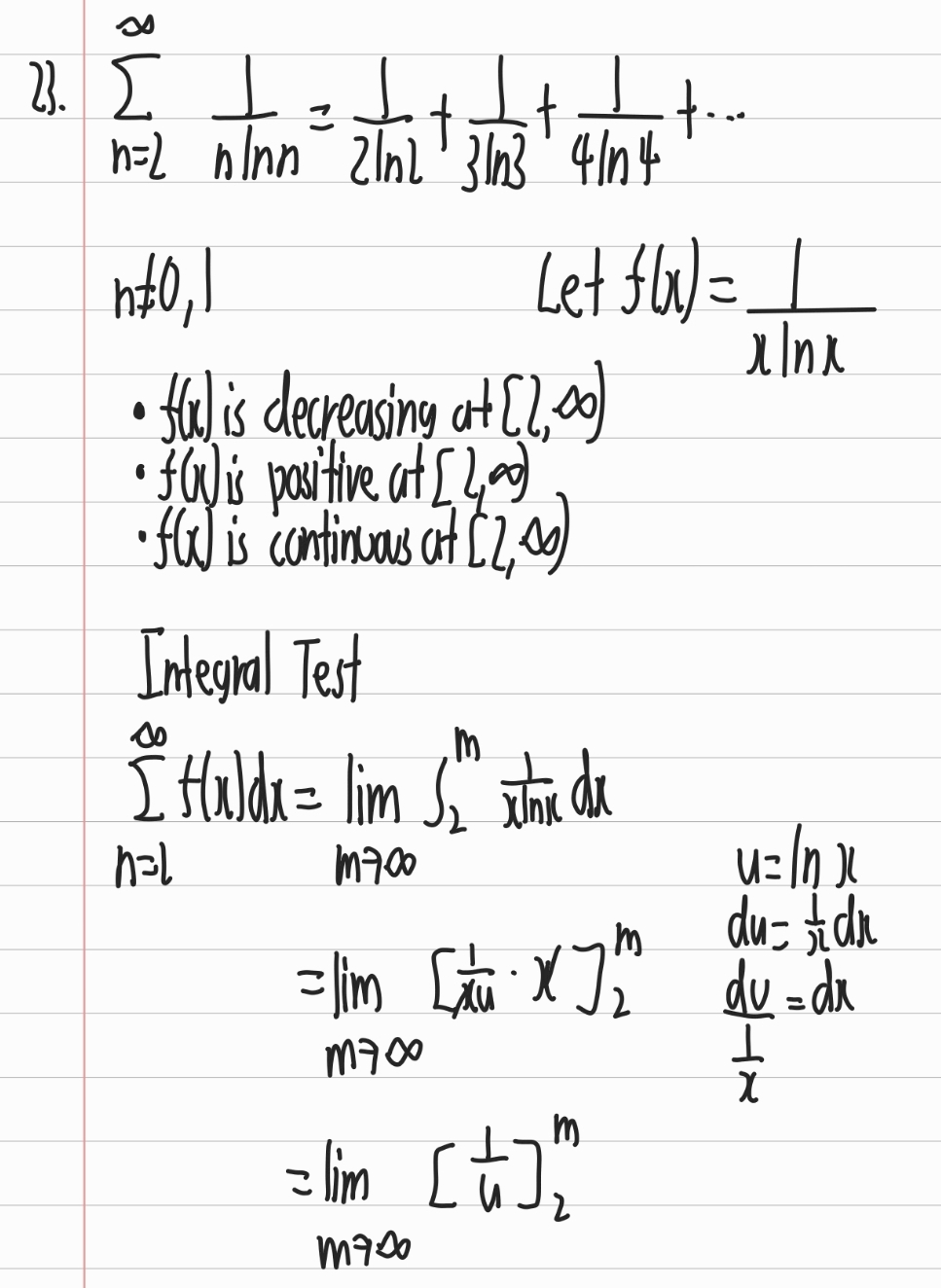
<p>We use the Integral Test here which is:</p>

<ul>
  <li>
    <p>If \(\int_2^\infty f(x) \, dx\) convergent, then \(\sum_{n=2}^{\infty} a_n\) is convergent.</p>
  </li>
  <li>
    <p>If \(\int_2^\infty f(x) \, dx\) convergent, then \(\sum_{n=2}^{\infty} a_n\) is divergent.</p>
  </li>
</ul>

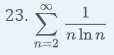
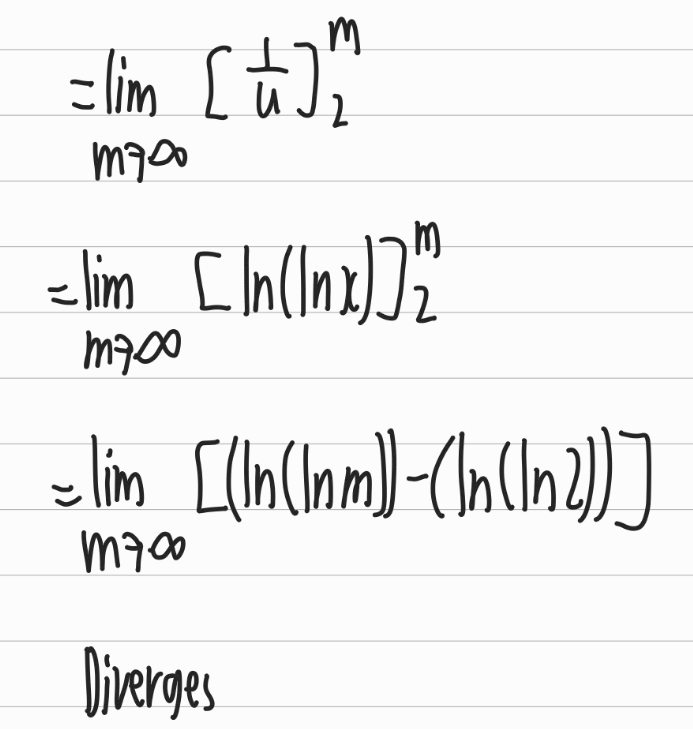
<p>Then you basically take the \(\lim_{m \to \infty} \int_2^m f(x) \, dx\) which in this case is \(\frac{1}{n \ln n}\).</p>

<p>You proceed to take the integral with U-Substitution and then finally taking the limit.</p>

<p>Since the limit does not equal to 0, it diverges which is the final answer.</p>

<h3 id="solutions">Solutions</h3>

<p><img src="/assets/images/SmartSelect_20230710_203332_Samsung Notes.jpg" width="800" height="600" /></p>

<p><img src="/assets/images/SmartSelect_20230710_203759_Samsung Notes.jpg" width="800" height="600" /></p>

<p><a href="/">&lt;— Return Home</a></p>]]></content><author><name>NOTORIEX LEGACY</name></author><category term="solutions" /><category term="written" /><category term="images" /><category term="textbook" /><category term="stewart" /><category term="Early Transcendentals" /><category term="calculusii" /><summary type="html"><![CDATA[]]></summary></entry><entry><title type="html">Textbook Section 11.3 Question 21 Solutions</title><link href="/solutions/written/images/TextbookSection11Part3Q21/" rel="alternate" type="text/html" title="Textbook Section 11.3 Question 21 Solutions" /><published>2023-07-10T20:32:00-07:00</published><updated>2023-07-10T20:32:00-07:00</updated><id>/solutions/written/images/TextbookSection11Part3Q21</id><content type="html" xml:base="/solutions/written/images/TextbookSection11Part3Q21/"><![CDATA[<script src="https://cdn.mathjax.org/mathjax/latest/MathJax.js?config=TeX-AMS-MML_HTMLorMML" type="text/javascript"></script>

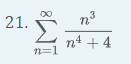
<h3 id="question">Question</h3>
<h3><i>Determine whether the series is convergent or divergent.</i></h3>
<p><img src="/assets/images/Textbook11-3Q21.png" width="800" height="600" /></p>

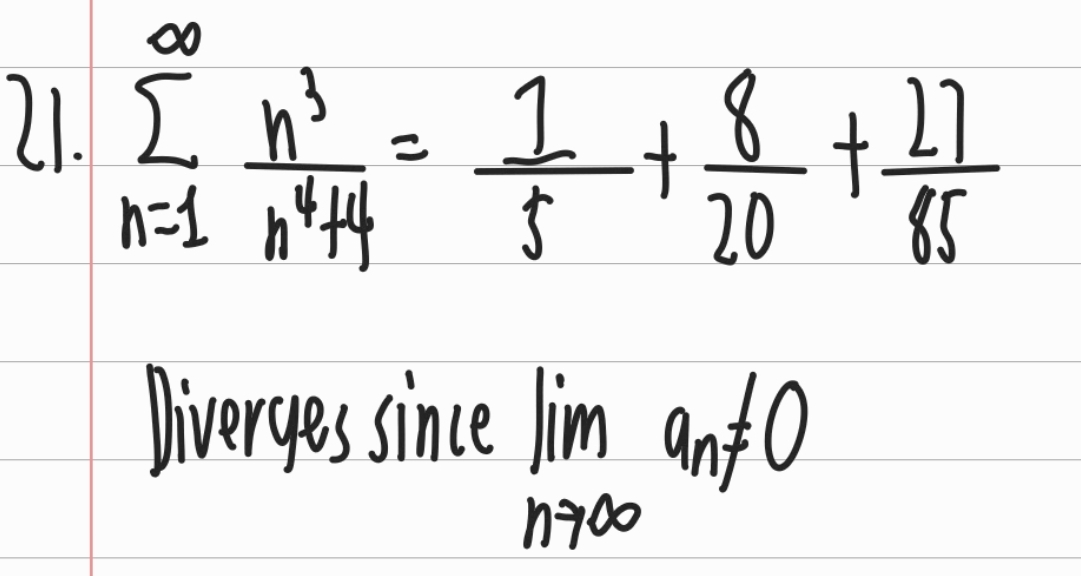
<h3 id="solutions">Solutions</h3>

<p><img src="/assets/images/SmartSelect_20230710_203103_Samsung Notes.jpg" width="800" height="600" /></p>

<p><a href="/">&lt;— Return Home</a></p>]]></content><author><name>NOTORIEX LEGACY</name></author><category term="solutions" /><category term="written" /><category term="images" /><category term="textbook" /><category term="stewart" /><category term="Early Transcendentals" /><category term="calculusii" /><summary type="html"><![CDATA[]]></summary></entry><entry><title type="html">Textbook Section 11.3 Question 19 Solutions</title><link href="/solutions/written/images/TextbookSection11Part3Q19/" rel="alternate" type="text/html" title="Textbook Section 11.3 Question 19 Solutions" /><published>2023-07-10T20:28:00-07:00</published><updated>2023-07-10T20:28:00-07:00</updated><id>/solutions/written/images/TextbookSection11Part3Q19</id><content type="html" xml:base="/solutions/written/images/TextbookSection11Part3Q19/"><![CDATA[<script src="https://cdn.mathjax.org/mathjax/latest/MathJax.js?config=TeX-AMS-MML_HTMLorMML" type="text/javascript"></script>

<h3 id="question">Question</h3>
<h3><i>Determine whether the series is convergent or divergent.</i></h3>
<p><img src="/assets/images/Textbook11-3Q19.png" width="800" height="600" /></p>

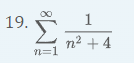
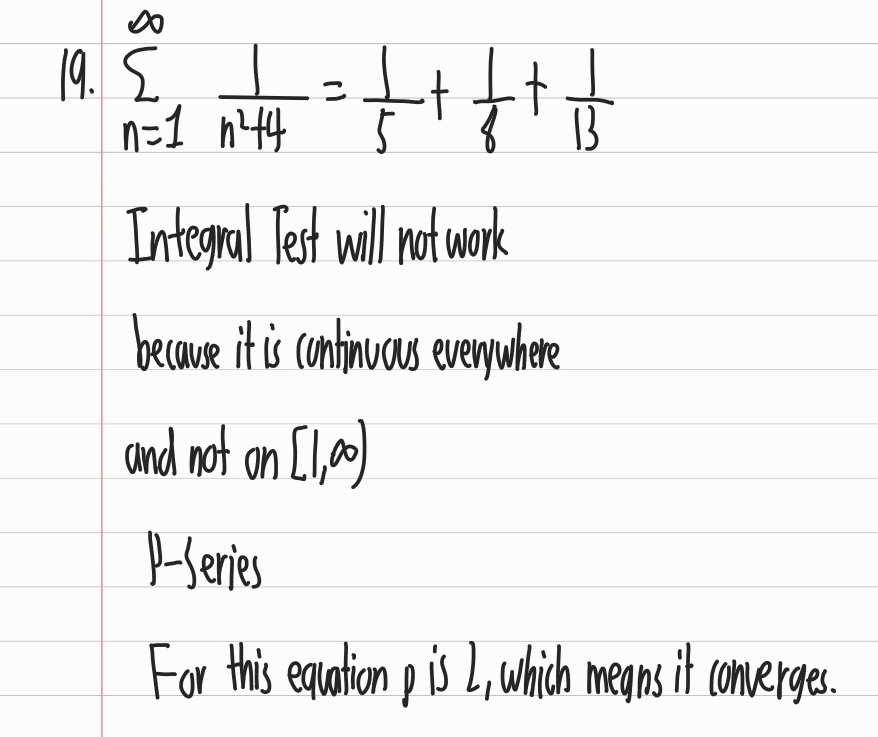
<p>The power-P rule of the Integral Test is applied!</p>

<hr />
<p><b>FIX: The Integral Test will actually work in this case!</b></p>

<h3 id="solutions">Solutions</h3>

<p><img src="/assets/images/SmartSelect_20230710_202621_Samsung Notes.jpg" width="800" height="600" /></p>

<p><a href="/">&lt;— Return Home</a></p>]]></content><author><name>NOTORIEX LEGACY</name></author><category term="solutions" /><category term="written" /><category term="images" /><category term="textbook" /><category term="stewart" /><category term="Early Transcendentals" /><category term="calculusii" /><summary type="html"><![CDATA[]]></summary></entry><entry><title type="html">Textbook Section 11.3 Question 17 Solutions</title><link href="/solutions/written/images/TextbookSection11Part3Q17/" rel="alternate" type="text/html" title="Textbook Section 11.3 Question 17 Solutions" /><published>2023-07-10T20:22:00-07:00</published><updated>2023-07-10T20:22:00-07:00</updated><id>/solutions/written/images/TextbookSection11Part3Q17</id><content type="html" xml:base="/solutions/written/images/TextbookSection11Part3Q17/"><![CDATA[<script src="https://cdn.mathjax.org/mathjax/latest/MathJax.js?config=TeX-AMS-MML_HTMLorMML" type="text/javascript"></script>

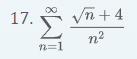
<h3 id="question">Question</h3>
<h3><i>Determine whether the series is convergent or divergent.</i></h3>
<p><img src="/assets/images/Textbook11-3Q17.png" width="800" height="600" /></p>

<p>First of all, we try to find out the summation series of the series.</p>

<p>Then, we use the Integral Test here which is:</p>

<ul>
  <li>
    <p>If \(\int_1^\infty f(x) \, dx\) convergent, then \(\sum_{n=1}^{\infty} a_n\) is convergent.</p>
  </li>
  <li>
    <p>If \(\int_1^\infty f(x) \, dx\) convergent, then \(\sum_{n=1}^{\infty} a_n\) is divergent.</p>
  </li>
</ul>

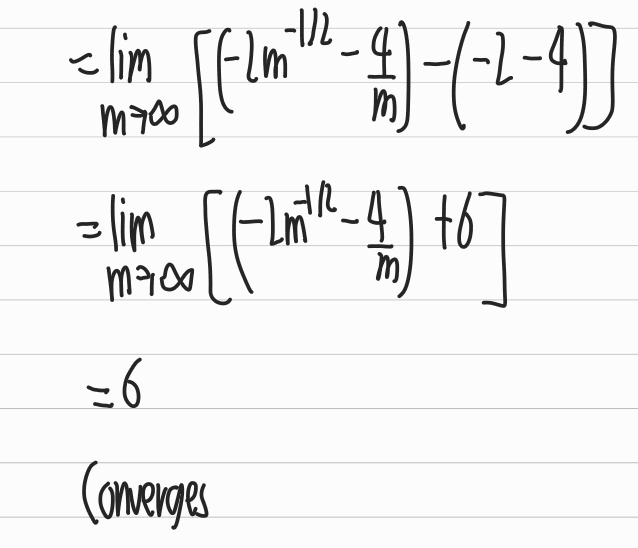
<p>Then you basically take the \(\lim_{m \to \infty} \int_1^m f(x) \, dx\) which in this case is \(\frac{\sqrt{n} + 4}{n^2}\).</p>

<p>You proceed to take the integral with Power Rule and then finally taking the limit.</p>

<p>Since the limit exists, it converges which is the final answer.</p>

<h3 id="solutions">Solutions</h3>

<p><img src="/assets/images/113 Practice_230710_124041 (5).jpg" width="800" height="600" /></p>

<p><img src="/assets/images/SmartSelect_20230710_202206_Samsung Notes.jpg" width="800" height="600" /></p>

<p><a href="/">&lt;— Return Home</a></p>]]></content><author><name>NOTORIEX LEGACY</name></author><category term="solutions" /><category term="written" /><category term="images" /><category term="textbook" /><category term="stewart" /><category term="Early Transcendentals" /><category term="calculusii" /><summary type="html"><![CDATA[]]></summary></entry><entry><title type="html">Textbook Section 11.3 Question 15 Solutions</title><link href="/solutions/written/images/TextbookSection11Part3Q15/" rel="alternate" type="text/html" title="Textbook Section 11.3 Question 15 Solutions" /><published>2023-07-10T20:20:00-07:00</published><updated>2023-07-10T20:20:00-07:00</updated><id>/solutions/written/images/TextbookSection11Part3Q15</id><content type="html" xml:base="/solutions/written/images/TextbookSection11Part3Q15/"><![CDATA[<script src="https://cdn.mathjax.org/mathjax/latest/MathJax.js?config=TeX-AMS-MML_HTMLorMML" type="text/javascript"></script>

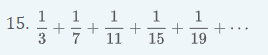
<h3 id="question">Question</h3>
<h3><i>Determine whether the series is convergent or divergent.</i></h3>
<p><img src="/assets/images/Textbook11-3Q15.png" width="800" height="600" /></p>

<p>First of all, we try to find out the summation series of the series.</p>

<p>Then, we use the Integral Test here which is:</p>

<ul>
  <li>
    <p>If \(\int_0^\infty f(x) \, dx\) convergent, then \(\sum_{n=0}^{\infty} a_n\) is convergent.</p>
  </li>
  <li>
    <p>If \(\int_0^\infty f(x) \, dx\) convergent, then \(\sum_{n=0}^{\infty} a_n\) is divergent.</p>
  </li>
</ul>

<p>Then you basically take the \(\lim_{m \to \infty} \int_0^m f(x) \, dx\) which in this case is \(\frac{1}{3+4x}\).</p>

<p>You proceed to take the integral with U-Substitution and then finally taking the limit.</p>

<p>Since the limit does not equal to 0, it diverges which is the final answer.</p>

<h3 id="solutions">Solutions</h3>

<p><img src="/assets/images/113 Practice_230710_124041 (3).jpg" width="800" height="600" /></p>

<p><a href="/">&lt;— Return Home</a></p>]]></content><author><name>NOTORIEX LEGACY</name></author><category term="solutions" /><category term="written" /><category term="images" /><category term="textbook" /><category term="stewart" /><category term="Early Transcendentals" /><category term="calculusii" /><summary type="html"><![CDATA[]]></summary></entry><entry><title type="html">Textbook Section 11.3 Question 13 Solutions</title><link href="/solutions/written/images/TextbookSection11Part3Q13/" rel="alternate" type="text/html" title="Textbook Section 11.3 Question 13 Solutions" /><published>2023-07-10T19:38:00-07:00</published><updated>2023-07-10T19:38:00-07:00</updated><id>/solutions/written/images/TextbookSection11Part3Q13</id><content type="html" xml:base="/solutions/written/images/TextbookSection11Part3Q13/"><![CDATA[<script src="https://cdn.mathjax.org/mathjax/latest/MathJax.js?config=TeX-AMS-MML_HTMLorMML" type="text/javascript"></script>

<h3 id="question">Question</h3>
<h3><i>Determine whether the series is convergent or divergent.</i></h3>
<p><img src="/assets/images/Textbook11-3Q13.png" width="800" height="600" /></p>

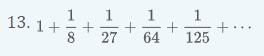
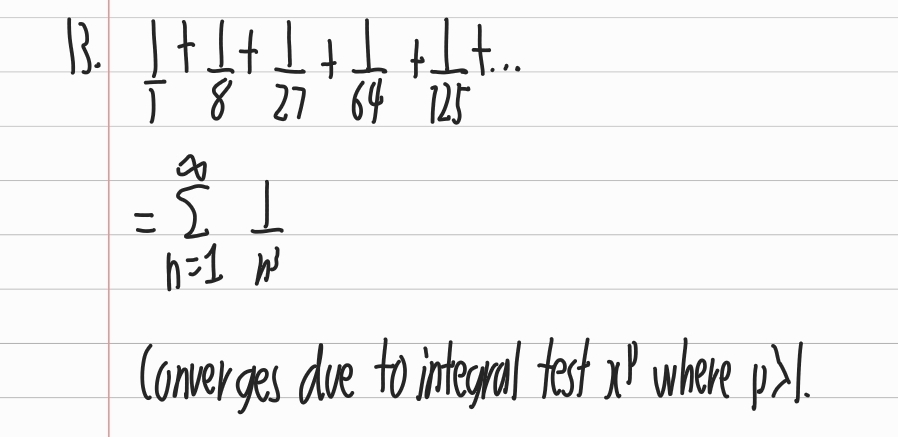
<p>The power-P rule of the Integral Test is applied!</p>

<h3 id="solutions">Solutions</h3>

<p><img src="/assets/images/SmartSelect_20230710_193718_Samsung Notes_1.jpg" width="800" height="600" /></p>

<p><a href="/">&lt;— Return Home</a></p>]]></content><author><name>NOTORIEX LEGACY</name></author><category term="solutions" /><category term="written" /><category term="images" /><category term="textbook" /><category term="stewart" /><category term="Early Transcendentals" /><category term="calculusii" /><summary type="html"><![CDATA[]]></summary></entry><entry><title type="html">Textbook Section 11.3 Question 11 Solutions</title><link href="/solutions/written/images/TextbookSection11Part3Q11/" rel="alternate" type="text/html" title="Textbook Section 11.3 Question 11 Solutions" /><published>2023-07-10T19:36:00-07:00</published><updated>2023-07-10T19:36:00-07:00</updated><id>/solutions/written/images/TextbookSection11Part3Q11</id><content type="html" xml:base="/solutions/written/images/TextbookSection11Part3Q11/"><![CDATA[<script src="https://cdn.mathjax.org/mathjax/latest/MathJax.js?config=TeX-AMS-MML_HTMLorMML" type="text/javascript"></script>

<h3 id="question">Question</h3>
<h3><i>Determine whether the series is convergent or divergent.</i></h3>
<p><img src="/assets/images/Textbook11-3Q11.png" width="800" height="600" /></p>

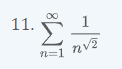
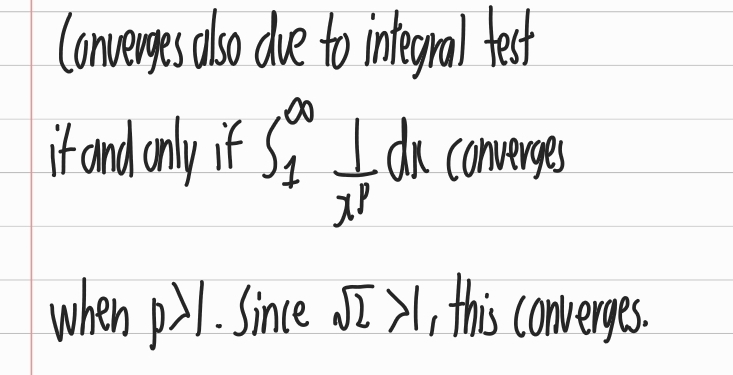
<p>We use the Integral Test here which is:</p>

<ul>
  <li>
    <p>If \(\int_1^\infty f(x) \, dx\) convergent, then \(\sum_{n=1}^{\infty} a_n\) is convergent.</p>
  </li>
  <li>
    <p>If \(\int_1^\infty f(x) \, dx\) convergent, then \(\sum_{n=1}^{\infty} a_n\) is divergent.</p>
  </li>
</ul>

<p>Then you basically take the \(\lim_{m \to \infty} \int_1^m f(x) \, dx\) which in this case is \(\frac{1}{n^{\sqrt{2}}}\).</p>

<p>You proceed to take the integral with Power Rule and then finally taking the limit.</p>

<p>Since the limit exists, it converges which is the final answer.</p>

<hr />

<p>The power-P rule of the Integral Test can also be applied here!</p>

<h3 id="solutions">Solutions</h3>

<p><img src="/assets/images/113 Practice_230710_124041 (2).jpg" width="800" height="600" /></p>

<p><img src="/assets/images/SmartSelect_20230710_193505_Samsung Notes.jpg" width="800" height="600" /></p>

<p><a href="/">&lt;— Return Home</a></p>]]></content><author><name>NOTORIEX LEGACY</name></author><category term="solutions" /><category term="written" /><category term="images" /><category term="textbook" /><category term="stewart" /><category term="Early Transcendentals" /><category term="calculusii" /><summary type="html"><![CDATA[]]></summary></entry></feed>