
Textbook Section 11.3 Question 9 Solutions
Question
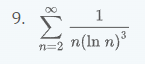
Use the Integral Test to determine whether the series is convergent or divergent.
This question has been critiqued by the TA.
Key Points:
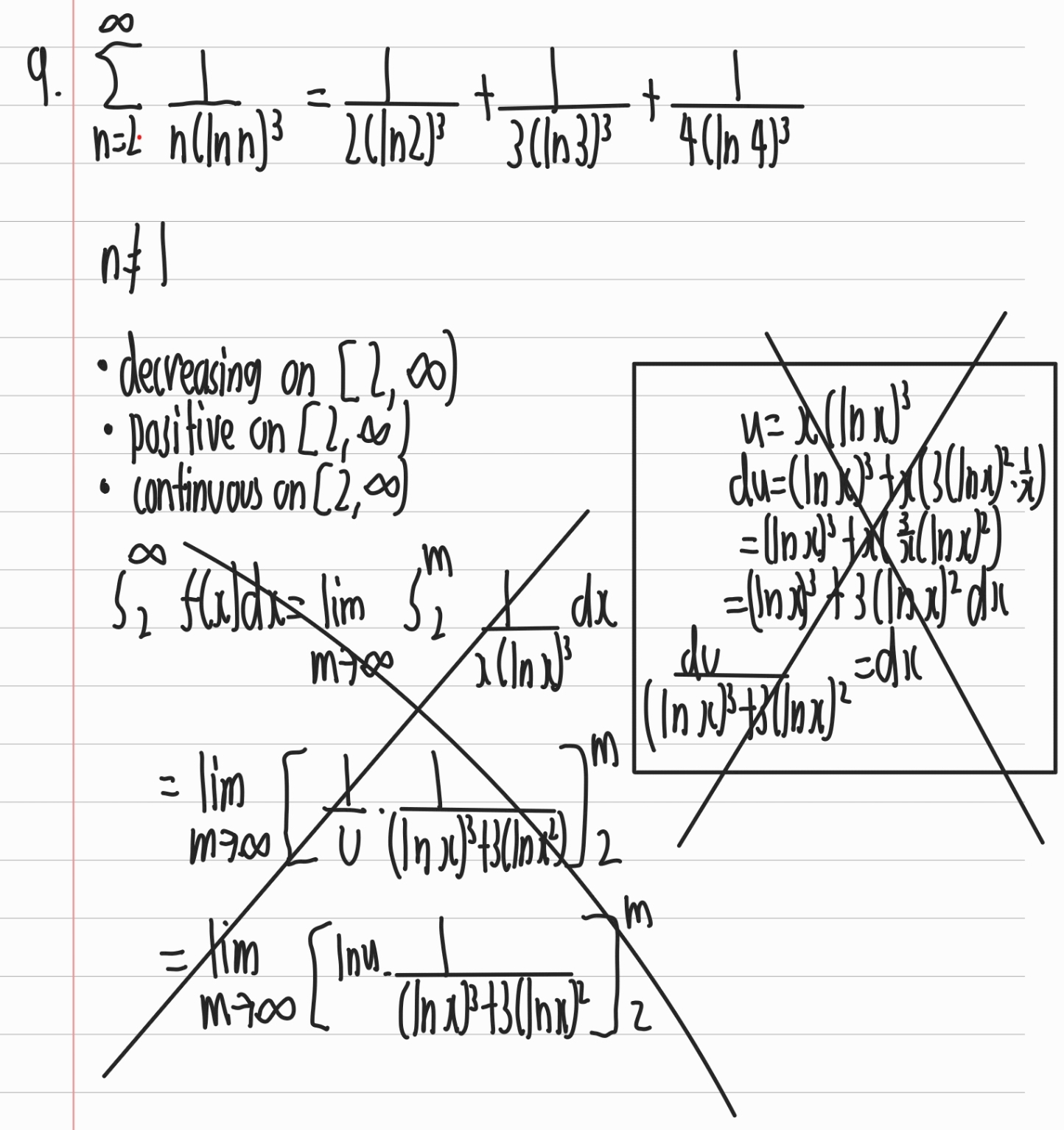
- if it is in the form of \(u\), you should have different integral points or else use integral of the what you had earlier.
- don’t skip steps since there is a step that’s been missed in the form of \((\frac{}{\ln x})\)
- say that it is less than \(\infty\)
We use the Integral Test here which is:
-
If \(\int_2^\infty f(x) \, dx\) convergent, then \(\sum_{n=2}^{\infty} a_n\) is convergent.
-
If \(\int_2^\infty f(x) \, dx\) convergent, then \(\sum_{n=2}^{\infty} a_n\) is divergent.
Then you basically take the \(\lim_{m \to \infty} \int_2^m f(x) \, dx\) which in this case is \(\frac{1}{x(\ln x)^3}\).
You proceed to take the integral with U-Substitution and then finally taking the limit.
Since the limit exists, it converges which is the final answer.
Solutions
.jpg)